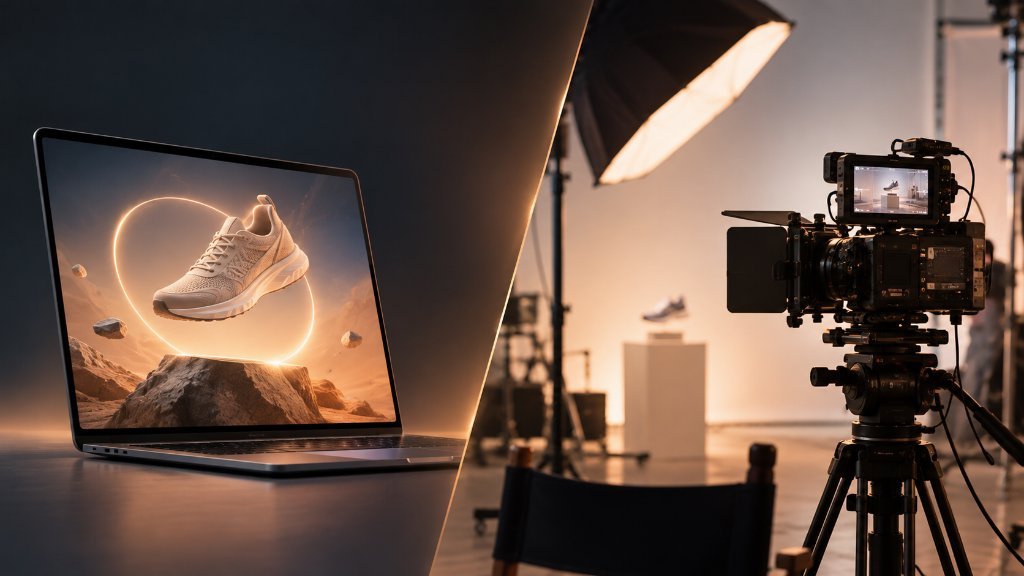
AI commercial ads use artificial intelligence, computer-generated imagery and digital production techniques to create brand advertisements. Live-action ads are filmed using real people, locations and physical sets. The right choice depends on your creative vision, budget, timeline, audience and production needs. Neither approach is automatically better; the best option is the one that serves your campaign.
A new campaign is taking shape. You have the concept, the product and a clear idea of what you want people to feel. But there is one important decision: should you shoot the advertisement or create it using AI?
AI commercial ads have made new creative approaches possible, but traditional filmmaking still has strengths that technology cannot simply replace.
Let's compare both approaches, understand their trade-offs and work out which makes sense for your next campaign.
What Are AI Commercial Ads, and How Do They Work?
AI commercial ads are advertisements created using artificial intelligence tools alongside creative direction, visual design, animation and post-production.
Instead of filming every scene with a physical camera, production teams can generate or build visual elements digitally. These may include environments, characters, product settings and cinematic sequences.
For example, imagine a skincare brand launching a new product. The creative idea involves a bottle floating through a surreal landscape, surrounded by flowers and flowing water. An AI-led production can help create this visual without building an elaborate physical set.
What goes into AI ad production?
Depending on the concept, the process may involve:
- Developing the script, storyboard and visual direction.
- Generating scenes, backgrounds or visual elements.
- Creating and refining product imagery.
- Adding animation, sound, editing and finishing.
- Reviewing brand consistency and final output quality.
AI-generated advertisements are not necessarily made with one click. Human creative decisions remain important throughout the process.
How Are AI Commercial Ads Different from Live-Action Shoots?
The biggest difference is how the visuals are produced. Live-action relies on physical filming, while AI-led production creates or modifies visuals digitally.
However, the difference goes beyond cameras and software. It affects creative flexibility, production planning, performance and the kind of realism your campaign needs.
| Factor | AI-led production | Live-action production |
|---|---|---|
| Visual creation | Generated or digitally built | Filmed in physical environments |
| Locations | Can create imagined settings | Requires accessible locations or sets |
| Performance | May use generated characters | Real actors and performances |
| Changes | Digital revisions may be easier | Reshoots may be necessary |
| Product realism | Requires careful validation | Physical product can be filmed directly |
| Creative control | Depends on tools and workflow | Depends on direction and production conditions |
Consider a travel brand advertising an imaginary destination. AI can help create landscapes that do not exist. But if the campaign needs authentic reactions from real travellers experiencing a particular hotel, live-action may communicate the experience more convincingly.
Neither method guarantees a better advertisement. Execution matters.
When Should Your Brand Choose AI Video Ads?
AI video ads make sense when the concept benefits from visual freedom, digital environments or production flexibility.
They can be particularly useful for brands that want to explore several creative directions without physically producing every visual variation.
Situations where AI works well
- Surreal concepts: Imagine a furniture brand showing a sofa floating above a city. AI can help create this imaginative setting.
- Product storytelling: A technology brand can visualise internal product functions or abstract ideas that are difficult to film.
- Multiple creative versions: A campaign may need different visual treatments for different audiences or platforms.
- Concept exploration: Teams can test visual ideas before committing to a full production.
This is where AI ad production can offer practical value. It gives creative teams another way to approach ideas that might otherwise require complex sets, locations or visual effects.
However, AI is not automatically faster or cheaper. Detailed revisions, inconsistent outputs and complex product requirements can increase production effort.
When Is a Live-Action Ad the Better Choice?
Live-action is often the stronger option when your campaign depends on genuine human emotion, physical product details or real-world credibility.
Think about a food brand launching a new product. Viewers may want to see its actual texture, packaging, ingredients and preparation. Filming the product directly can make those details easier to trust.
Live-action also works well for founder interviews, customer stories, real workplace environments and campaigns built around authentic performances.
Can you combine both approaches?
Yes. A hybrid production uses live-action footage and AI-generated or digitally enhanced elements in the same advertisement.
For example, a fashion brand could film its model and clothing traditionally, then use AI-assisted environments to create different campaign settings.
This approach can retain the authenticity of real products and performances while offering more creative freedom.
What Should You Check Before Choosing AI Ad Production?
Before deciding, look beyond the production method. Start with the campaign objective and identify what the audience needs to see or believe.
A few common mistakes can create problems later:
- Choosing AI just because it is trending. Technology should solve a creative or production problem, not become the campaign idea itself.
- Ignoring product accuracy. Check packaging, logos, colours, proportions and product details carefully.
- Expecting perfect results immediately. AI outputs need selection, refinement and quality checks.
- Overlooking usage rights. Review permissions for tools, assets, likenesses, voices and music.
- Forgetting platform requirements. Plan aspect ratios, duration, formats and deliverables before production begins.
A useful starting point is a clear brief covering the audience, message, visual references, deliverables and approval process.
For a more detailed discussion of production possibilities, explore Digikore AI's content production services.
Frequently Asked Questions
Are AI commercial ads worth it?
They can be, particularly when digital production supports the creative idea or makes complex visuals practical. Their value should be judged through production costs, audience response and campaign performance.
Are AI-generated advertisements suitable for every industry?
No. Industries that depend heavily on physical product accuracy, demonstrations or personal trust may need live-action or a hybrid approach. The concept and audience should guide the decision.
Can AI ads look realistic?
Yes, but realism depends on the tools, creative direction and refinement involved. Hands, faces, text, packaging and product details may need additional attention.
How much does AI ad production cost?
There is no fixed price. Complexity, duration, revisions, assets, sound design and finishing requirements all influence the estimate. A defined brief is the best starting point.
Can AI and live-action be used in the same advertisement?
Yes. Combining real footage with AI-generated environments or visual effects can provide a balance between authenticity and creative flexibility.
The right advertisement starts with the right production decision. Whether you choose AI, live-action or a combination, begin with the story you want your audience to remember.
Planning your next campaign? Book a consultation with Digikore Studios Ltd to discuss your concept and explore the right production approach.